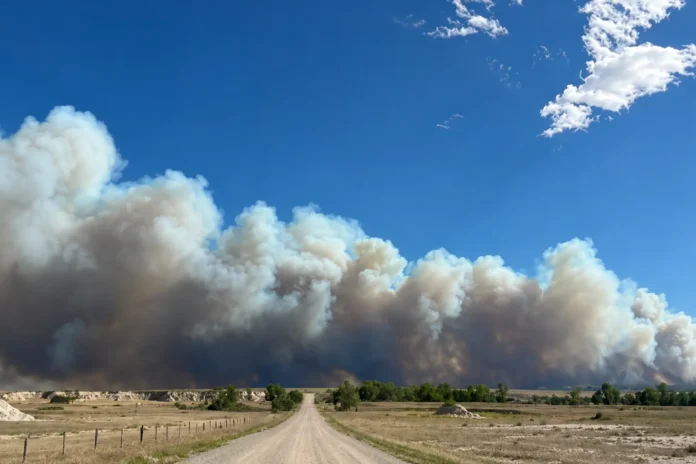

Smoke Across Nebraska Skies Signals Growing Danger
Heavy smoke spread across the Nebraska Panhandle as wildfire conditions worsened rapidly Wednesday evening. Residents near Fort Robinson monitored emergency updates while flames expanded across dangerous rugged terrain.
Soon afterward, emergency officials issued evacuation orders affecting structures and vulnerable community residents nearby. Authorities ordered evacuations for Fort Robinson State Park and sections surrounding Crawford afterward. Officials confirmed ninety five residents and twenty two structures remained under active evacuation orders.
Meanwhile, firefighters battled difficult conditions while strong winds complicated containment efforts throughout affected regions. Forest officials reported the South Fork Fire covered nearly nine thousand acres across rugged terrain. Emergency responders struggled against dangerous conditions while additional mapping efforts continued throughout wildfire affected areas. Communities throughout the Nebraska Panhandle faced growing uncertainty beneath smoke filled skies and advancing flames.
Rugged Hills and Wind Push Flames Across Communities
As wildfire conditions worsened, emergency crews confronted dangerous terrain throughout northwestern Nebraska overnight afterward. Strong winds pushed flames rapidly while smoke reduced visibility across vulnerable rural communities nearby.
Meanwhile, firefighters battled difficult conditions near Crawford and Fort Robinson throughout dangerous nighttime operations. Rugged hills and dry vegetation allowed flames toward additional areas surrounding evacuation zones afterward. Emergency crews worked continuously while unpredictable winds complicated containment efforts across affected wildfire regions.
According to state officials, advancing flames threatened structures throughout portions surrounding Crawford afterward. Authorities maintained evacuation zones while emergency responders monitored vulnerable residential and commercial properties closely. Firefighters attempted protection efforts while dangerous wildfire conditions intensified throughout surrounding rural communities overnight. Residents followed emergency instructions carefully while uncertainty spread beneath smoke filled Nebraska skies afterward.
Elsewhere, emergency officials warned conditions remained hazardous despite growing statewide firefighting support overnight afterward. Governor Jim Pillen confirmed National Guard helicopter units assisted local firefighters battling dangerous flames. Federal forest service crews deployed additional resources while responders confronted exhausting overnight wildfire operations. The South Fork Fire exposed how rapidly wildfire threats overwhelm isolated communities across rugged Great Plains terrain.
Shelter Plans and Emergency Crews Race Against Time
Beyond firefighting operations, emergency officials coordinated shelter plans for displaced Nebraska residents overnight afterward. Communities across affected counties searched urgently for temporary refuge from advancing wildfire conditions nearby.
Meanwhile, the Red Cross established community shelter options for evacuated residents throughout affected regions. Chadron State College offered Andrews Hall for residents from Crawford and Sioux counties afterward. College officials warned evacuees bedding and meals would remain unavailable despite temporary shelter assistance.
At the same time, transportation disruptions complicated emergency response efforts across wildfire affected Nebraska corridors. Authorities closed Highway 20 between Harrison and Crawford because dangerous wildfire conditions intensified nearby. Emergency officials attempted safer travel coordination while smoke and flames threatened surrounding transportation routes. Residents monitored highway updates carefully while evacuation efforts continued throughout vulnerable Nebraska communities afterward.
Consequently, state and federal agencies expanded cooperation while dangerous wildfire conditions persisted overnight afterward. Governor Jim Pillen confirmed Nebraska National Guard helicopter units supported overwhelmed local firefighting crews. Federal forest service teams deployed additional assets while emergency responders battled flames through rugged terrain. Coordinated emergency operations highlighted growing pressure upon disaster response systems throughout vulnerable rural Great Plains communities.
Nightfall Leaves Nebraska Communities Facing Uncertain Days
After smoke covered western Nebraska, many residents still faced uncertainty regarding wildfire containment efforts. Rural communities recognized how rapidly dangerous fires threaten homes, roads, and emergency infrastructure.
Nevertheless, fast moving wildfires continue challenging emergency responders across isolated American communities regularly afterward. Limited evacuation time and rugged terrain often complicate containment efforts during dangerous wildfire outbreaks. Emergency coordination remains essential while firefighters protect vulnerable residents and threatened regional infrastructure overnight.
Ultimately, growing wildfire threats increasingly reshape public safety planning across the Great Plains region. Communities now depend upon stronger preparedness strategies while dangerous weather conditions intensify wildfire risks statewide. Residents across rural Nebraska recognize emergency resilience requires cooperation between local and federal agencies. Wildfires leave lasting uncertainty while exhausted communities await safer conditions beneath smoke filled skies.

CALAMITY360.com delivers global news and safety insights on earthquakes, tsunamis, volcanic eruptions, floods, wildfires, storms, and tornadoes. It provides timely updates, expert tips, and disaster-readiness information to foster awareness, preparedness, and resilience across communities worldwide.