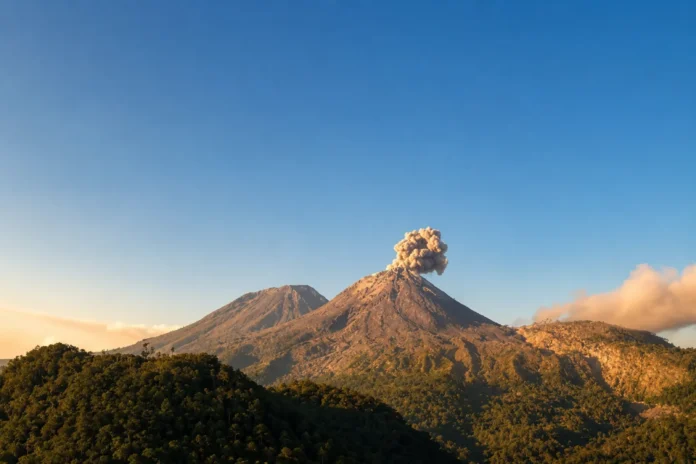

Ash Columns Rose Above Restless Flores Skies
Mount Lewotobi Laki-laki erupted repeatedly Friday morning across Indonesia’s East Flores region nationwide. Officials recorded five separate eruptions between early morning hours and approaching midday periods. Thick gray ash plumes rose approximately three hundred through one thousand meters above summit.
Meanwhile, volcano observers reported relatively clear visibility despite thin mist surrounding portions nearby mountain slopes. Thin white crater smoke also rose approximately fifty through one hundred meters above summit. Officials confirmed Mount Lewotobi Laki-laki remains under Alert Level Three amid continuing volcanic instability. Residents across surrounding communities again faced uncertainty beneath increasingly restless volcanic conditions throughout East Flores.
Additionally, officials from the volcano observation post closely monitored changing eruption activity throughout Friday. Bramantya Aji Putra Mahendra described repeated ash emissions during official volcanic observation updates. Authorities continued tracking plume heights, crater conditions, and visibility changes surrounding the volcano. Renewed eruptions revived regional concerns regarding possible escalation beneath Indonesia’s volatile geological landscape.
Volcanic Tremors Reveal Growing Pressure Beneath Craters
Meanwhile, seismic instruments continued recording unusual underground activity beneath Mount Lewotobi Laki-laki throughout Friday. Officials detected two gust earthquakes alongside several tremors connected toward continuing volcanic instability. Those underground disturbances raised additional concerns regarding pressure buildup beneath the active volcano.
Authorities reported gust earthquakes produced amplitudes between 2.9 and 4.4 millimeters during monitoring. Each gust earthquake lasted approximately thirty one through thirty two seconds beneath volcanic terrain. Officials also recorded three separate non harmonic tremors during continuing eruption activity nearby.
Additionally, non harmonic tremors produced amplitudes between 4.4 and 7.4 millimeters during observations. Those tremors lasted approximately eighty five through one hundred thirty five seconds beneath Mount Lewotobi. Experts often associate prolonged seismic disturbances with unstable magma movement beneath volcanic crater systems. Such geological signals may indicate continuing pressure changes within deeper volcanic structures below ground.
Visual observations also revealed thin white crater smoke above Mount Lewotobi Laki-laki throughout Friday. Officials said smoke columns reached approximately fifty through one hundred meters above summit afterward. Observers continued monitoring crater conditions closely because changing smoke patterns sometimes indicate instability.
Elsewhere, lava deposits extended several kilometers away from the active eruption center across Flores. Authorities observed lava deposits stretching northeast and west northwest from Mount Lewotobi afterward. Those expanding lava deposits reinforced concerns regarding continuing volcanic activity beneath surrounding mountain slopes.
Authorities Expand Warnings Across Vulnerable Communities
Meanwhile, Indonesian authorities quickly expanded safety warnings across vulnerable East Flores communities after eruptions. Officials urged residents avoiding dangerous areas surrounding Mount Lewotobi Laki-laki during continuing instability. Government agencies also reinforced coordination efforts amid escalating volcanic threats across nearby districts.
PVMBG prohibited public activities within five kilometers surrounding the active eruption center afterward. Authorities warned residents and visitors against entering restricted zones near dangerous volcanic slopes. Officials feared sudden eruptions could threaten communities located too closely beside Mount Lewotobi.
Additionally, ashfall concerns prompted health advisories throughout several communities surrounding East Flores afterward. Officials encouraged residents wearing masks or covering mouths against dangerous volcanic ash exposure. Volcanic ash particles often threaten respiratory health during prolonged eruptions beneath shifting atmospheric conditions. Authorities continued reminding communities about protective measures during periods of heavier ashfall nearby.
Elsewhere, officials expressed concern regarding rain triggered lava floods near vulnerable regional river systems. Authorities specifically warned communities near Dulipali, Padang Pasir, Nobo, and Nurabelen about possible dangers. Klatanlo, Hokeng Jaya, Boru, and Nawakote also remained vulnerable during intense rainfall periods.
Consequently, government agencies urged residents remaining calm despite continuing volcanic instability across East Flores. Officials repeatedly encouraged communities following verified instructions from authorized disaster management authorities nationwide. Authorities also requested stronger coordination between local governments, PVMBG, and volcano observation officials.
Communities Brace Beneath Indonesia’s Volcanic Uncertainty
Afterward, recurring eruptions continued testing disaster preparedness across vulnerable Indonesian communities near Mount Lewotobi. Residents throughout East Flores remained alert because volcanic conditions could rapidly worsen without warning. Continuing instability also reinforced fears regarding ashfall, lava flows, and dangerous seismic disturbances.
Likewise, reliable volcanic monitoring remained essential throughout Indonesia’s highly active geological regions afterward. Officials depended upon observation data and seismic analysis for accurate public safety advisories nationwide. Strong coordination between government agencies also proved crucial during unpredictable volcanic emergency situations. Public cooperation remained equally important whenever authorities issued evacuation warnings or restricted dangerous areas.
Ultimately, communities across the Pacific Ring of Fire continue facing unpredictable volcanic threats beneath shifting geological forces. Mount Lewotobi Laki-laki once again demonstrated nature’s destructive power across densely populated vulnerable regions. Future safety depends upon preparedness, scientific monitoring, and disciplined public responses during volcanic emergencies.

CALAMITY360.com delivers global news and safety insights on earthquakes, tsunamis, volcanic eruptions, floods, wildfires, storms, and tornadoes. It provides timely updates, expert tips, and disaster-readiness information to foster awareness, preparedness, and resilience across communities worldwide.